Why does the heat conduction of PTFE thin-walled tubes occur faster than that of thick-walled tubes?
Why does the heat conduction of PTFE thin-walled tubes occur faster than that of thick-walled tubes?
The core factor is the thermal resistance, and the wall thickness determines the heat transfer path.
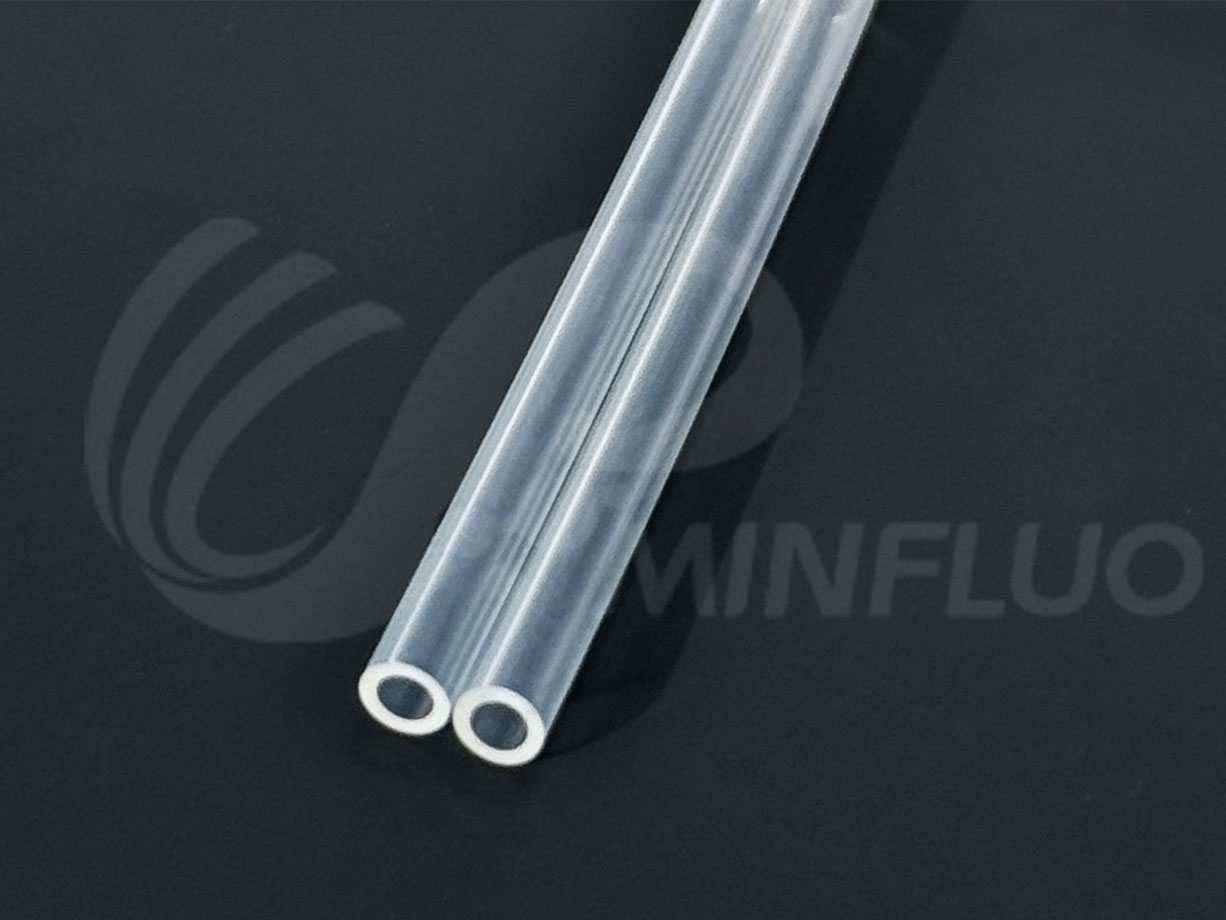
The inherent thermal conductivity of PTFE is relatively weak, and the tube wall is the main resistance layer for heat transfer. When heat transfers from the inside of the tube to the outside, it needs to pass through the entire tube wall. The thinner the wall thickness, the shorter the distance that heat needs to travel, and the lower the thermal resistance. Under the same temperature difference between the inside and outside, the smaller the thermal resistance, the faster the heat transfer rate. This is the fundamental logic behind the faster heat transfer of thin-walled tubes.
For thick-walled PTFE tubes, heat needs to pass through more polymer materials, and there are more energy transfer links between molecules. The temperature gradient is elongated, and the resistance to heat penetration through the tube wall significantly increases. Even if the raw material is completely the same, only changing the wall thickness will result in significant differences in heat transfer performance. For PTFE materials with low thermal conductivity, the heat resistance brought by the tube wall often becomes the main limiting factor in the entire heat exchange system. The impact of changes in wall thickness is amplified.
Structural characteristics of cylindrical wall heat transfer
Pipe materials belong to cylindrical structures and differ from flat plate heat transfer. In thick-walled tubes, the difference in inner and outer radii is large, and the heat transfer area along the radial direction constantly changes, further increasing the heat transfer obstruction; in thin-walled tubes, the inner and outer dimensions are close, and the heat transfer state is closer to a flat wall, and heat transfer is more smooth. In heat exchange conditions, thin-walled tubes can establish temperature linkage on both sides of the tube wall more quickly, and the temperature change in the tube interior can be quickly reflected on the outer wall. In thick-walled tubes, there will be a significant temperature lag, and the temperature rise and fall responses will be slower.
It should be noted that what is mentioned here is the **heat transfer rate**, not the change in the thermal conductivity properties of PTFE itself. The thermal conductivity coefficient of the material is determined by the molecular structure and will not change due to thinning. It only shortens the distance that heat travels and reduces the obstruction.
Selection and trade-off, heat transfer and pressure-bearing balance
The advantages of thin-walled tubes in heat transfer are prominent, but there are performance trade-offs. After the wall thickness is reduced, the pressure-bearing capacity and resistance to external force impact of the pipe material decrease, and the performance in terms of resistance to negative pressure and compression is not as good as that of thick-walled tubes. During processing and use, deformation is more likely to occur. Therefore, in heat exchangers, heating protection, temperature control pipelines, etc., thin-walled PTFE tubes are preferred, taking into account corrosion prevention and heat transfer efficiency; if the working conditions are high pressure, negative pressure, or prone to impact, thick-walled tubes need to be added to sacrifice some heat transfer performance for structural safety.
At the same time, convective heat transfer on the surface will also jointly affect the overall effect. The temperature of the thin-walled tube's wall is closer to the medium temperature, and the temperature difference between the tube wall and the fluid is more stable, and the convective heat transfer efficiency is easier to be exerted; in thick-walled tubes, the temperature difference between the inner and outer walls is large, and the difference in temperature between the outer wall and the medium is obvious, and the overall heat transfer efficiency is limited.
Key points for practical application control
When selecting PTFE pipe materials, one should not blindly pursue thin walls to improve heat transfer. In addition to pressure, factors such as thermal cycling, medium corrosion, installation bending, etc. should also be considered. Uniformity of wall thickness is also crucial; local thickening will form a local high point of thermal resistance, causing uneven heat transfer. In heat exchange system design, usually, within the limits of pressure resistance and service life, an appropriate thin-walled specification is selected to balance heat transfer efficiency, corrosion resistance, and structural stability.