At a temperature of 200℃, what are the fundamental differences between FEP heat shrink tubing and PTFE heat shrink tubing?
At a temperature of 200℃, what are the fundamental differences between FEP heat shrink tubing and PTFE heat shrink tubing?
In the fields of electronics and electrical engineering, chemical engineering, and healthcare, FEP heat shrink tubing and FEP heat shrink tubing are both common high-performance protective materials. Both possess characteristics such as high temperature resistance, corrosion resistance, and high insulation. However, their performance varies significantly in an environment of 200℃. Many purchasers often struggle when choosing the type: should they opt for FEP or PTFE? Below, we will help you compare them from two key aspects.
Thermal resistance and stability at high temperatures
Both can be used for a long time at high temperatures, but the specific temperature range and their performance under high temperatures are different.
Long-term usage temperature limit: The long-term usage temperature of FEP heat shrink tubing is typically between -80℃ and +200℃. The long-term usage temperature limit of PTFE heat shrink tubing can reach +260℃. If your application environment is constantly close to or exceeds 200℃, PTFE is a more reliable choice. However, if the working temperature is 200℃ or below, FEP is fully capable of handling the task.
Dimensional stability at high temperatures: The thermal expansion coefficient of PTFE is relatively large at high temperatures. When heated and contracting, a higher temperature is required, and the dimensional stability after contraction is better. The FEP heat shrink tube, due to its lower melting temperature of the material itself, needs to be confirmed whether the wall thickness and fit after heat shrinking meet the requirements for long-term insulation or sealing when used at 200℃ for a long time. Jiangsu Mingfu has been deeply engaged in the field of fluorine material extrusion tubes. The team has over 25 years of extrusion experience and can recommend suitable material solutions based on your actual working conditions.
Cost-benefit consideration: The price of FEP heat shrink tubing is usually lower than that of PTFE heat shrink tubing. If 200℃ is already your maximum usage temperature limit, FEP is a more cost-effective choice; if there is temperature fluctuation in the application or if long-term tolerance to an environment close to 250℃ is required, PTFE has a greater temperature tolerance margin.
II. Transparency and Appearance Inspection
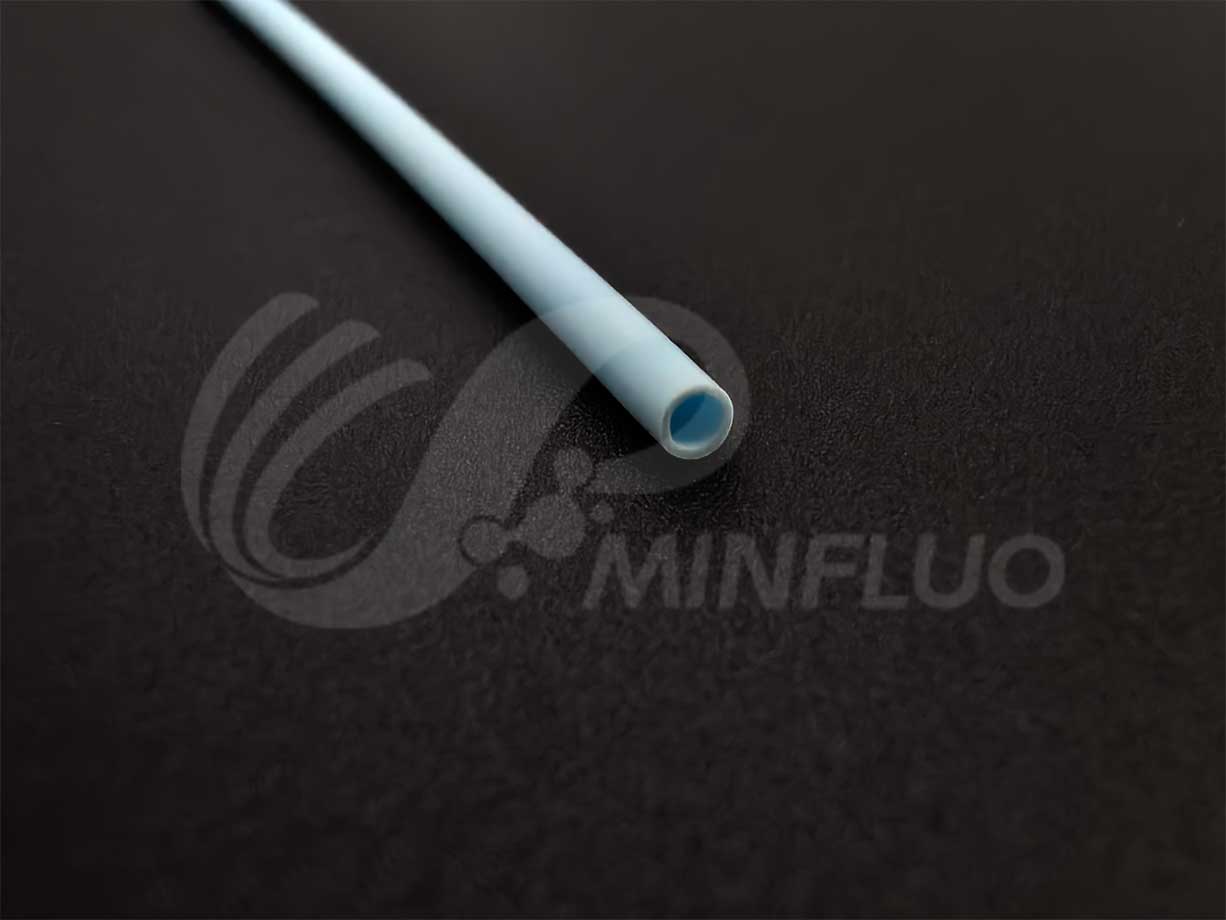
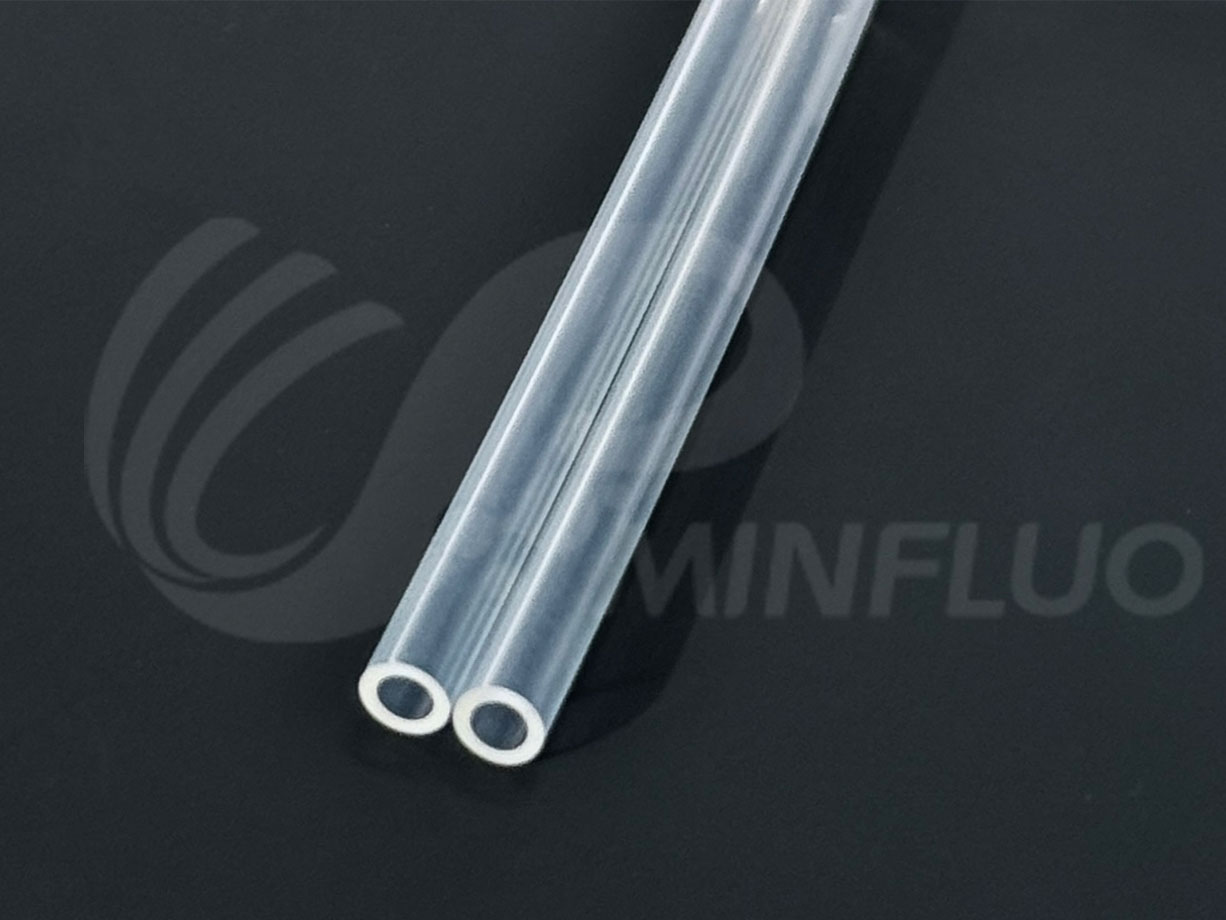
One notable advantage of FEP heat shrink tubing is its native transparency, while PTFE heat shrink tubing is usually semi-transparent or white opaque.
The transparency advantage of FEP: The most obvious feature of FEP heat shrink tubing is its inherent transparent texture. There is no need for additional coloring to directly observe the internal components and pipeline conditions. This means that during electrical maintenance and medical pipeline inspections, one can directly see whether the covered objects are corroded, damaged, or displaced, making it easier to detect problems at an early stage. PTFE heat shrink tubing, due to its semi-transparent or opaque properties, cannot achieve this function.
Application scenario differences: For situations where regular visual inspection of the internal condition is required (such as in electronic wiring harnesses and precision sensor protection), the transparent characteristic of FEP heat shrink tubing is an added advantage. For scenarios where only simple protection is needed and no internal observation is required (such as in chemical pipeline joint seals), PTFE heat shrink tubing can also handle the job.
Summary and Selection Suggestions
When purchasing heat shrink tubing, it is recommended to make the selection based on the following principles:
Check the temperature limit: For long-term use, the temperature should be below 200℃. The FEP heat shrink tubing is sufficient and offers better cost-effectiveness; if the temperature frequently approaches 250℃ or higher, PTFE heat shrink tubing should be chosen.
Check if transparency is required: If a visual inspection of the internal condition is necessary, the transparent property of the FEP heat shrink tubing cannot be replaced; if only sealing or insulation protection is needed, PTFE is equally reliable.
Choose based on the contraction ratio rather than the demand: Both can offer different contraction ratios (such as 2:1, 4:1). The choice can be made according to the outer diameter of the covered object and the final fitting requirements.
Jiangsu Minfluo New Material Technology Co., Ltd. specializes in the field of fluorine material extrusion tubes. It has obtained ISO9001 and ISO13485 certifications for medical device quality management systems. The company offers FEP heat shrink tubes, FEP fluid tubes, PTFE multi-chamber tubes, and Pebax tubes, among others. It can recommend material options based on the working conditions. Please feel free to communicate your specific requirements and request sample tests.
Official website: http://www.minfluo.com